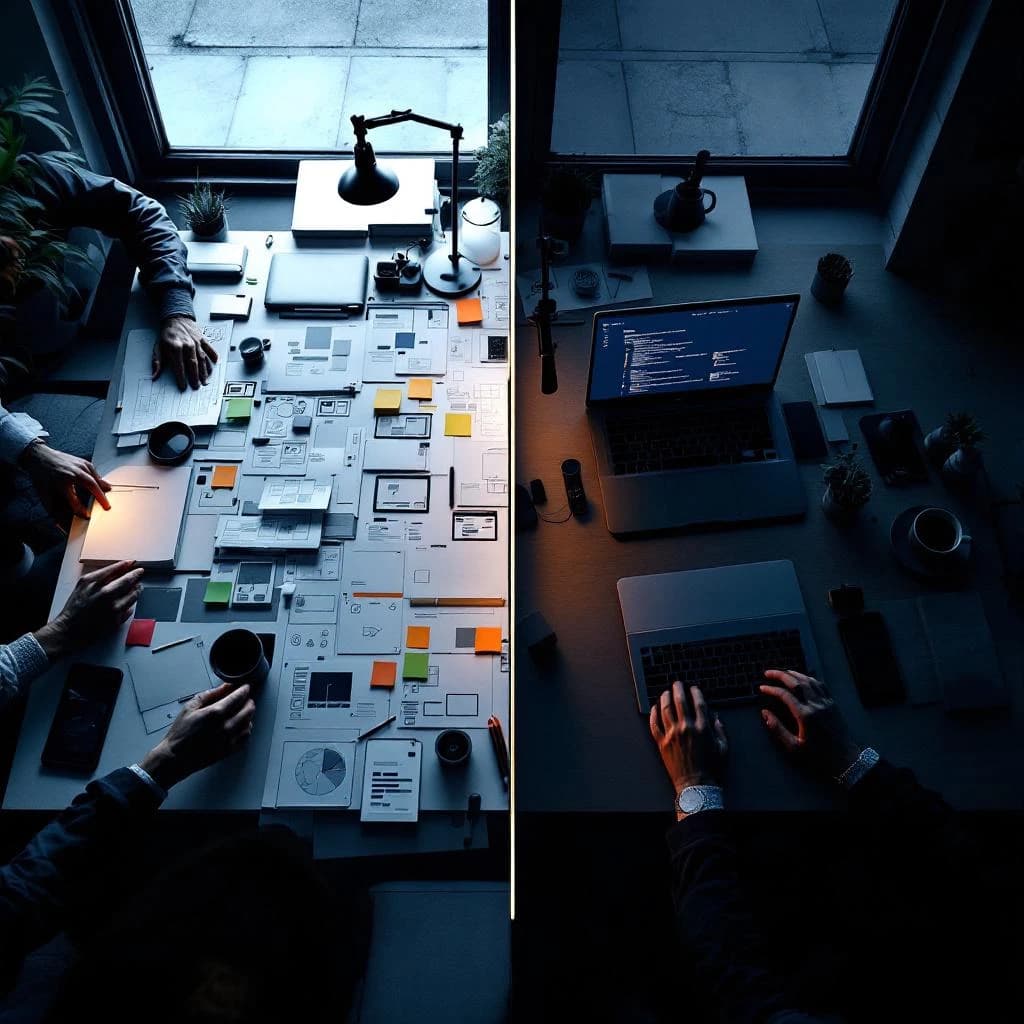
Claude Design is exposing an uncomfortable truth about traditional design processes: most of what teams charged premium rates for was coordination overhead and formatting busywork disguised as creative strategy. When founders now ship complete prototypes in 48 hours using AI tools, the three-week design sprint reveals itself not as creative necessity but as organizational bloat. The traditional design workflow wasn't optimized for output quality. It was optimized to justify headcount, retainers, and the appearance of rigor.
This isn't about AI replacing creativity. It's about automation finally drawing a bright line between strategic design thinking and the tactical execution work we pretended required the same expertise.
What Claude Design Actually Does Differently Than Traditional Design Workflows
Claude Design collapses what used to be a multi-week, multi-handoff process into iterative conversations. You describe what you need, Claude generates wireframes or mockups, you refine through dialogue, and the tool produces production-ready artifacts.
Traditional agency workflows required distinct phases: discovery calls, stakeholder interviews, mood boards, wireframe reviews, high-fidelity mockups, revision rounds, and final delivery. Each phase had its own timeline and billing increment. A simple landing page redesign could easily span two to three weeks and cost $8,000 to $15,000.
With Claude Design, that same project happens in hours. You're not waiting for the junior designer to finish wireframes so the senior designer can review them so the art director can present them to you so you can request changes that restart the cycle. No coordination tax.
The speed difference alone is notable. But what really matters is how this speed exposes the inefficiency that was always there.
Why Design Sprints Are Becoming Obsolete With AI Tools
The five-day design sprint became gospel in the 2010s. It promised to compress months of work into one week through structured facilitation and time constraints. Agencies charged $25,000 to $50,000 to run them.
Here's what nobody wanted to admit: design sprints were expensive solutions to coordination problems, not creative problems. You needed the structure because getting stakeholders aligned, designers synchronized, and decisions made required formal process overhead.
AI tools eliminate roughly 70% of the coordination burden that justified design sprints in the first place. When one person can generate, iterate, and refine design concepts in real-time conversation, you don't need facilitated workshops to build alignment. You need clear strategic intent and the judgment to evaluate output quality.
The ROI calculation has flipped. A design sprint's value was speed relative to traditional timelines. But when AI delivers comparable output in one day instead of five, the sprint's remaining value is the forced strategic thinking, not the design artifacts it produces. That's a much harder sell at $40,000.
How AI Design Tools Are Eliminating Junior Design Execution Work
Traditional design teams had a clear hierarchy: junior designers handled wireframes and component libraries, mid-level designers created high-fidelity mockups, and senior designers made strategic decisions. This structure made economic sense when each tier required distinct skills.
AI has automated the bottom two tiers almost completely. The work that occupied junior designers for 30 to 40 hours per week (creating wireframes, adjusting spacing, building component variations, formatting copy) now happens in minutes through conversational prompts.
Component libraries were particularly labor-intensive. Building a complete design system with buttons, forms, navigation elements, and responsive variants could take a junior designer 80 to 120 hours. Claude Design generates functional component libraries in an afternoon with consistent styling and proper documentation.
This creates an uncomfortable reality for design teams: the career ladder just lost its bottom rungs. There's no longer an economic justification for hiring someone at $50,000 to $65,000 annually to do work that AI handles as a marginal cost.
The phrase "paying your dues" in design used to mean spending years doing execution work before earning strategic responsibility. That pathway no longer exists because the execution work no longer needs humans. If you're entering design now, you need to start with strategic skills or you're competing with tools that cost $20 per month.
Strategic Design Thinking vs Execution in the AI Era
So what remains valuable when AI handles execution? Strategic design thinking, but the definition is narrower and more demanding than most designers want to admit.
Strategic thinking includes user research interpretation, brand positioning decisions, information architecture that reflects actual user mental models, and the judgment to know when a design solves the right problem versus just looking polished. These skills require business context, user empathy, and the pattern recognition that comes from seeing what works across different contexts.
Here's the problem: traditional design teams charged strategic rates for all their work, not just the strategic parts. A $150 per hour designer wasn't thinking strategically for all 40 billable hours each week. Maybe 10 to 15 hours involved genuine strategic decisions. The rest was execution that AI now commoditizes.
This is why certain AI design tools caused major market reactions when they launched. Investors immediately understood the margin compression coming for design tools and agencies built on execution work.
The new economic reality splits design into two categories: strategy work that commands premium rates because it requires human judgment, and execution work that's essentially free because AI handles it. The middle ground where most designers operated? It's disappearing.
What Traditional Design Process Actually Optimized For
If traditional design workflows weren't optimized for speed or output quality, what were they optimized for? Billable hours, team utilization, and the appearance of rigor.
Agencies needed processes that kept teams busy and created natural billing milestones. The multi-week timeline with distinct phases wasn't about creativity. It was about revenue recognition and resource allocation. You can't bill a client $30,000 for something that takes three hours, even if those three hours produce better results.
Internal design teams faced similar pressures. A five-person design team needs to justify its existence through visible process and regular deliverables. Design sprints, critique sessions, and component library maintenance create legible work that signals value to leadership.
None of this makes designers malicious. It makes them rational actors in an economic system that rewarded process over outcomes. But that system is breaking down because AI eliminates the market friction that made it sustainable.
How to Right-Size Creative Teams With AI Design Tools
If you're managing a design team or paying for design services, here's the framework for evaluating what you actually need going forward.
Audit Your Current Design Spend by Activity Type
Break down what your team or agency actually does into three categories: strategic decisions, execution work, and coordination overhead. Be honest about the ratio. Most teams discover they're spending 60% to 70% of time and budget on execution and coordination, not strategy.
For each execution task (wireframing, mockup creation, component building), test whether AI tools can match the output quality. Don't compare the AI's first attempt to your team's final polished work. Compare what AI produces in one hour to what your team produces in one hour.
Redefine Roles Around Judgment and Strategy
The designers you keep should be the ones who excel at strategic thinking, user research, and the judgment to evaluate AI output critically. Their job shifts from creating artifacts to directing AI creation and making the decisions AI can't.
This probably means fewer designers with higher individual capability. One senior strategic designer working with AI tools will outproduce three-person teams built around the traditional junior-to-senior progression.
Understanding how to give Claude AI proper context becomes as important as traditional design skills because prompt quality directly determines output quality.
Renegotiate Agency Relationships Around Outcomes
If you're paying monthly retainers to design agencies, it's time for an honest conversation about what you're buying. The old model of paying $15,000 per month for a certain number of "design hours" makes no sense when AI compresses the work.
Shift to project-based pricing tied to specific outcomes or value-based fees for strategic consulting. If an agency pushes back by defending their process, that's your signal they're selling coordination overhead, not design value.
The Counter-Argument: What Still Requires Human Designers
Look, none of this means design becomes worthless or fully automated. But we need honest boundaries around what still requires human expertise.
Complex information architecture for products with multiple user types genuinely needs human strategic thinking. Brand positioning that connects to emotional drivers and market context requires human insight. Accessibility considerations for diverse user needs benefit from human empathy and advocacy.
User research is perhaps the most defensible design skill in the AI era. Understanding why users behave certain ways, identifying unmet needs, and translating research insights into design requirements all require human judgment that AI can't replicate from training data alone.
The work that remains valuable is the work that requires understanding business context, user psychology, and strategic trade-offs. Everything else is execution, and execution is now commoditized.
Design Sprint ROI in the AI Era: The New Math
Let's run the numbers on what design sprints actually cost versus deliver now that AI alternatives exist.
Traditional design sprint: $35,000 in agency fees, 40 hours of internal stakeholder time, five business days of calendar time. Deliverables include sketches, prototypes, user testing results, and a strategic direction.
AI-assisted alternative: One strategic designer working with Claude Design over two days. Cost: approximately $3,000 in labor plus $20 in AI tool costs. Deliverables include comparable prototypes, faster iteration based on stakeholder feedback, and the same strategic direction.
The math is brutal for traditional approaches. You're paying 10x to 12x more for work that takes 2.5x longer and produces similar output quality. The only remaining justification is if the forced facilitation and stakeholder alignment deliver value beyond the design artifacts themselves.
For some organizations with serious alignment problems, that facilitation value might justify the cost. For most, it's expensive theater that masked how much time was coordination overhead rather than creative work.
Similar economic pressures are reshaping other technical fields. Understanding how to position yourself in generative AI roles matters because the skills that survive automation in design are similar to those that matter across AI-impacted disciplines.
What This Means for Your Design Budget Going Forward
If you're spending more than $5,000 per month on design work that's primarily execution (landing pages, email templates, ad creative, basic web pages), you're overpaying by roughly 60% to 80% compared to what AI-assisted workflows now cost.
The defensible design budget going forward pays for strategic consulting, user research, complex information architecture, and the judgment to evaluate and refine AI output. That's valuable work, but it's fewer hours at higher rates, not ongoing retainers for execution capacity.
For in-house teams, this means shifting from design production departments to lean strategic design functions. Two senior designers who understand business strategy and can direct AI tools will deliver more value than five-person teams built around traditional workflows.
The uncomfortable truth is that Claude Design didn't reveal new capabilities. It revealed that most of what we called design process was coordination tax and formatting work we ritualized into professional methodology. Now that the automation line has been drawn, there's no going back to pretending execution work justifies strategic pricing.
Want to go deeper?
AI consulting for agencies, consultancies, and pro-services firms.
Where AI multiplies billable output without breaking the work.
AI in 90 Days: What Mid-Market Companies Should Actually Do About AI Right Now
Almost four out of five mid-market companies have made an AI move and four out of five of those moves haven't shipped anything. Here's the 90-day plan that works, three traps to avoid, three workflows to deploy, one number per workflow.
Read the white paper →Get a free AI-powered SEO audit of your site
We'll crawl your site, benchmark your local pack, and hand you a prioritized fix list in minutes. No call required.
Run my free audit