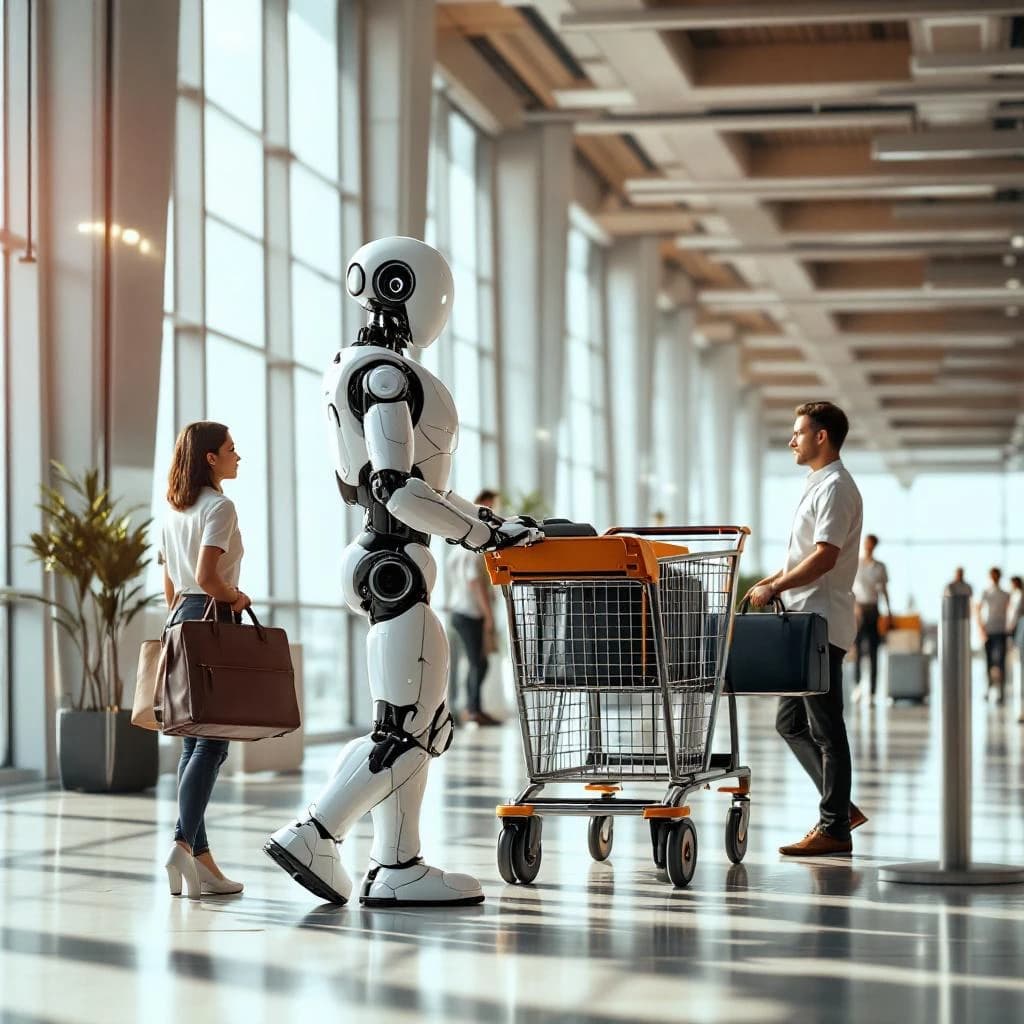
Humanoid robots are working in airports, data centers, and warehouses right now, not five years from now. Japan Airlines deployed humanoid robots for baggage handling and cabin cleaning in 2025 to solve labor shortages. Unitree's G1 humanoid costs $4,290, putting the technology within reach of small businesses for the first time. Meanwhile, SoftBank's Roze AI is building autonomous robot-powered data centers with $100 billion IPO ambitions. You can evaluate these systems today with specific pricing, capabilities, and deployment examples that show what's commercially available versus what's still vaporware.
What Are Humanoid Robots Actually Doing in Commercial Settings Right Now
Humanoid robots in 2025 focus on repetitive, physically demanding tasks where labor shortages hit hardest. Japan Airlines uses humanoid robots to move baggage between carts and aircraft holds, a job that requires bending, lifting, and working in tight spaces. The same robots clean aircraft cabins between flights, wiping down tray tables and overhead bins.
SoftBank's Roze AI deploys humanoid robots in data centers to handle server maintenance, cable management, and equipment monitoring. These robots work 24/7 in environments where human technicians find it uncomfortable to spend long hours. The company claims its autonomous data center model reduces operational costs by approximately 35% compared to traditionally staffed facilities.
Warehouse automation represents the largest commercial deployment category. Humanoid robots pick items from shelves, pack boxes, and transport goods between stations. Unlike specialized warehouse robots that only perform one task, humanoids adapt to multiple roles using the same hardware platform. This matters when you're calculating ROI on a $4,000-$16,000 investment.
Why Humanoid Robot Pricing Dropped From Six Figures to Under $5,000
The Unitree G1 humanoid robot costs $4,290 for the base model and $16,000 for the fully equipped version with advanced hands and sensors. This represents a 95% price reduction compared to 2020, when comparable humanoid platforms cost $100,000 or more. Chinese manufacturing scale, commodity component availability, and standardized control systems drove prices down.
Boston Dynamics' Atlas remains a research platform without public pricing, but industry estimates place it above $150,000 per unit. Tesla's Optimus humanoid targets a $20,000-$30,000 price point for production models, though actual commercial availability remains unclear as of mid-2025.
The sub-$5,000 price threshold matters because it puts humanoid robots in the same capital expenditure category as industrial equipment that small businesses already buy. A commercial floor scrubber costs $3,000-$8,000. A forklift runs $15,000-$30,000. When humanoid robots hit these price points, purchasing decisions shift from "experimental R&D" to "standard equipment evaluation."
Honestly, the speed of this price collapse caught most industry analysts off guard, including those who predicted sub-$10K humanoids by 2027.
How to Evaluate Humanoid Robot Capabilities for Your Business
Start by identifying tasks that meet specific criteria: repetitive motion patterns, physically demanding for humans, difficult to staff consistently, and measurable performance standards. Cleaning, material handling, and inspection work fit this profile. Customer-facing roles and complex problem-solving don't, at least not yet.
Assess Physical Specifications Against Your Requirements
The Unitree G1 stands 1.32 meters tall, weighs 35 kilograms, and carries payloads up to 2 kilograms. It walks at 2 meters per second and operates for approximately 2 hours on a single battery charge. Compare these specs to your actual task requirements, not theoretical capabilities.
If you need to move 20-kilogram boxes, current affordable humanoid robots won't work. If you need to inspect equipment, wipe surfaces, or transport small items, the specifications align. Most businesses overestimate what they need and underestimate what current robots can actually do. It's a consistent pattern.
Calculate Real Operating Costs Beyond Purchase Price
Factor in charging infrastructure ($500-$2,000 for commercial charging stations), maintenance contracts (typically 10-15% of purchase price annually), and programming time. Initial setup and training take 40-80 hours for businesses without robotics experience, based on early adopter reports from warehouse operators.
Insurance costs vary widely. Some commercial policies cover robotics equipment as standard business property. Others require separate riders that add $300-$1,200 annually per unit. Check with your insurer before purchasing, because you'll need clarity on liability coverage too.
Test Integration With Your Existing Workflows
Current humanoid robots use visual recognition systems and pre-programmed movement sequences, similar to agentic AI systems that combine perception with action. They don't improvise well when environments change unexpectedly.
Run a pilot deployment in a controlled area before rolling out across your facility. Japan Airlines tested its baggage-handling robots on a single aircraft type for three months before expanding to its full fleet. The robots struggled with unexpected obstacles like misplaced cargo straps and required software updates to handle edge cases. And honestly, most teams skip this testing phase, then wonder why deployment fails.
What Jobs Can Humanoid Robots Actually Perform in 2025
Commercial humanoid robots excel at tasks with clear success criteria and structured environments. Here's what's working in real deployments versus what's still experimental.
Proven Commercial Applications
Baggage handling in airports involves moving luggage between carts, conveyor belts, and aircraft holds. Japan Airlines reports that humanoid robots handle approximately 200 bags per shift, compared to 300-350 for human workers. The robots work consistently without fatigue but move more slowly and require human intervention when bags jam or fall.
Facility cleaning covers floor sweeping, surface wiping, and trash collection in controlled environments. Robots clean aircraft cabins, office buildings, and warehouse floors. They follow predetermined routes and adapt to minor obstacles but need human assistance for spills, heavy debris, or areas blocked by equipment. That's the reality.
Warehouse inventory inspection involves scanning barcodes, checking shelf placement, and identifying misplaced items. Humanoid robots equipped with cameras and RFID readers achieve 92-96% accuracy rates, comparable to human workers but without the ergonomic strain of repetitive reaching and bending.
Data center equipment monitoring includes checking server status lights, reading temperature displays, and performing visual inspections for physical damage or cable disconnections. SoftBank's Roze AI reports that robots identify approximately 85% of issues that human technicians would catch during routine rounds.
Experimental Applications Not Ready for Production
Customer service roles remain problematic. Robots struggle with natural conversation, emotional intelligence, and handling unexpected requests. Airport concierge robots can answer basic questions from a script but fail when customers ask follow-up questions or speak with strong accents.
Food preparation requires precision manipulation that current affordable humanoids can't reliably perform. Expensive research platforms demonstrate cooking capabilities in controlled demonstrations, but commercial deployment faces food safety certification challenges and consistency problems.
Complex assembly work needs fine motor control and real-time problem-solving that exceeds current capabilities at the sub-$20,000 price point. Specialized robotic arms still outperform humanoids for manufacturing tasks. Just the truth.
Affordable Humanoid Robots for Small Business: Real Options in 2025
Small businesses can now access humanoid robotics at price points that make financial sense for specific use cases. Here's what's actually available for purchase, not just announced.
Unitree G1: $4,290-$16,000
The Unitree G1 ships to commercial customers in 2025 with a 3-4 month lead time. The base model ($4,290) includes basic manipulation capabilities suitable for simple picking, placing, and inspection tasks. The advanced model ($16,000) adds dexterous hands with individual finger control and enhanced sensors for complex manipulation.
Businesses report using G1 robots for warehouse inventory checks, facility cleaning, and basic material transport. Setup requires technical knowledge comparable to configuring industrial automation equipment. If you've programmed a CNC machine or set up a warehouse management system, you can configure a G1. It's not rocket science, but it's not plug-and-play either.
Collaborative Options From Established Robotics Companies
Boston Dynamics doesn't sell Atlas humanoids commercially, but its Spot quadruped robot ($75,000) performs many similar inspection and monitoring tasks. This isn't a humanoid form factor, but it's available now with proven reliability in commercial deployments.
Several Chinese manufacturers offer humanoid robots in the $8,000-$25,000 range with capabilities similar to Unitree's offerings. U.S. legislative efforts to restrict Chinese robotics imports may affect availability, but as of mid-2025, these products remain purchasable through international distributors.
Lease and Robot-as-a-Service Models
Some providers offer humanoid robots on monthly subscription models starting at $500-$1,200 per month with maintenance included. This shifts capital expenditure to operational expense and reduces risk for businesses testing automation for the first time.
The economics work when you're replacing labor costs exceeding $3,000 per month, which applies to many warehouse, cleaning, and inspection roles in high-cost labor markets. Calculate your fully loaded labor cost (wages plus benefits, training, and turnover costs) before comparing to robot subscription fees. Don't forget turnover, that's where the hidden costs pile up.
How Autonomous Robots in Data Centers Actually Work
SoftBank's Roze AI represents the most ambitious commercial deployment of humanoid robots in 2025, with plans to build fully autonomous data centers operated primarily by robots. Understanding this model shows where commercial robotics is heading beyond individual task automation.
Roze AI's data centers use humanoid robots for server installation, cable management, equipment monitoring, and routine maintenance. Robots work alongside a small human technical team (approximately 8-10 people managing facilities that would typically require 40-50 staff) that handles complex troubleshooting and strategic decisions.
The robots operate on predetermined schedules but adapt to real-time conditions using computer vision and sensor data. When a server shows warning indicators, robots photograph the display, run diagnostic checks, and alert human technicians if the issue requires intervention beyond their programmed responses.
This hybrid model, combining structured AI systems with human oversight, represents the realistic near-term future of commercial robotics. Full autonomy remains years away, but supervised automation with 70-80% task completion by robots is commercially viable now.
Understanding Legislative and Supply Chain Challenges
U.S. legislative proposals to restrict Chinese-manufactured robotics face practical challenges that affect your purchasing decisions. Most affordable humanoid robots come from Chinese manufacturers, and alternative suppliers can't match current pricing.
The supply chain for robotics components is globally distributed. Motors, sensors, and control systems come from multiple countries. Even "American-made" robots typically contain 40-60% Chinese components by value. Complete supply chain decoupling would increase prices by an estimated 150-200% based on component sourcing analysis. That's a big jump.
For business buyers, this creates planning uncertainty. Purchase decisions in 2025 should account for potential price increases or availability restrictions in 2026-2027. Leasing arrangements may provide more flexibility than outright purchases if regulatory changes affect the market.
Calculating ROI on Commercial Humanoid Robot Deployments
Return on investment calculations for humanoid robots follow standard capital equipment models but require realistic capability assessments. Most businesses overestimate robot productivity in year one and underestimate long-term value as software improves.
A $16,000 humanoid robot that replaces 30% of a full-time worker's tasks (realistic for current capabilities) saves approximately $12,000-$18,000 annually in labor costs, assuming a $40,000-$60,000 fully loaded employee cost. Add $2,000 in annual maintenance and electricity costs. Payback period: 14-18 months.
This assumes the robot actually performs as expected, which depends heavily on how well your tasks match robot capabilities. Japan Airlines achieved 65% of expected productivity in the first six months, improving to 85% after software updates and workflow adjustments. That's a pretty typical learning curve.
The Pentagon's investment in combat robotics and SoftBank's $100 billion IPO ambitions for Roze AI signal institutional confidence in commercial robotics economics. These aren't consumer products or experimental technologies anymore. They're capital equipment with calculable returns.
Look, you can deploy humanoid robots in your business today if your use case matches current capabilities: repetitive tasks, structured environments, and tolerance for 80-90% automation rather than full replacement. Start with a single unit in a controlled application, measure actual performance against your specific requirements, and scale based on results. The technology has moved from "interesting future possibility" to "evaluate like any other automation investment" faster than most businesses realize.
Get a free AI-powered SEO audit of your site
We'll crawl your site, benchmark your local pack, and hand you a prioritized fix list in minutes. No call required.
Run my free audit