AI tools built for financial advisors now advertise compliance features, but most of what you'll see in demos is marketing-grade compliance, not audit-grade compliance. The difference matters when your CCO faces a third-party review or an SEC exam. Marketing-grade compliance means the vendor has encryption and a terms-of-service paragraph about data handling. Audit-grade compliance means you can produce a defensible trail that shows who reviewed what, when, and under what supervisory process. Jump, Zocks, and FP Alpha are the advisor-AI tools most often mentioned in compliance conversations. Here's what actually holds up.
What Marketing-Grade vs Audit-Grade Compliance Actually Means
Marketing-grade compliance sounds good in a sales deck. The vendor will tell you they're "SOC 2 compliant," data is "encrypted in transit and at rest," and they "take privacy seriously." None of that tells you whether the tool generates records you can defend in an audit.
Audit-grade compliance answers a different question: if a regulator or third-party auditor asks to see how AI-generated content was reviewed, approved, and supervised, can you produce a time-stamped, attributable record? Can you show that a principal or supervised person reviewed the output before it went to a client? Can you prove the AI didn't make a recommendation you failed to catch? These aren't theoretical concerns.
The gap shows up in books and records requirements under SEC Rule 204-2. If the AI tool doesn't log who edited what, or if it auto-saves drafts without version control, you're left reconstructing supervision after the fact. That's the failure mode most RIAs don't discover until the exam notice arrives.
Jump AI Compliance for Financial Advisors: What Actually Holds Up
Jump is the only advisor-AI tool I've reviewed where the compliance posture was clearly built by someone who's sat through an SEC exam. The platform logs every AI interaction, timestamps edits, and attributes them to named users. You can pull a report that shows which principal reviewed which AI-generated email before it was sent.
The supervision workflow is the part that matters. Jump requires a human approval step before AI-drafted client communications leave the platform. That approval is logged. If your compliance consultant or auditor asks to see your supervisory procedures for AI-generated content, you can point to a system-enforced gate, not a policy document your staff may or may not follow.
Jump also maintains a third-party review-ready audit trail. In one pilot with a $240M RIA, the CCO exported six months of AI activity logs in under two minutes. The export included user IDs, timestamps, original AI output, human edits, and approval signatures. That's audit-grade.
The cost is higher than competitors. Expect $150 to $250 per advisor per month depending on seat count and feature set. But if you're already paying for a compliance consultant to retrofit supervision workflows around a cheaper tool, the gap closes fast.
Zocks AI Audit Trail: Where the Meeting-Note Play Falls Short
Zocks is popular because it automates meeting transcription and generates client follow-up emails from recorded calls. The feature works. The compliance gap is that Zocks doesn't enforce human-in-the-loop review before those emails go out.
The platform will transcribe a 45-minute client meeting, extract action items, and draft a summary email. If you click send without reading it, Zocks has no supervisory control to stop you. The audit trail shows the email was sent, but it doesn't show that a principal reviewed the AI's interpretation of what was said.
That's a problem under FINRA Rule 3110 and SEC supervision requirements. If the AI mischaracterizes a conversation or includes an unintended recommendation, and you didn't catch it, you own the compliance failure. Zocks will tell you their transcription accuracy is above 92%, but accuracy isn't the issue. The issue is whether you can prove supervisory review happened.
One $80M RIA using Zocks discovered this during a mock audit. The compliance consultant asked to see records proving that a principal had reviewed AI-generated client emails before they were sent. Zocks could show that emails were sent and that the advisor had access to the transcript. It couldn't show that anyone read the email before it went out. The RIA ended up building a manual log in a separate system, which defeated the automation value. And honestly, most teams skip this part.
Zocks costs roughly $80 to $120 per advisor per month. It's useful if you treat it as a transcription tool and layer your own review process on top. It's not a compliance-ready solution out of the box.
FP Alpha Compliance Review: The Planning-Side Supervision Question
FP Alpha uses AI to assist with financial plan generation, scenario modeling, and plan commentary. The output quality is strong. The compliance question is whether your firm has the supervisory infrastructure to review AI-assisted plans before they're delivered to clients.
Most RIAs under $500M don't have a dedicated planning supervisor. If your firm operates with individual advisors responsible for their own plan review, adding AI into the workflow creates a new supervisory obligation. You now need a process to ensure the AI didn't introduce an error, omit a material risk, or make an assumption that doesn't fit the client's situation.
FP Alpha doesn't enforce a secondary review step. It assumes the advisor using the tool is the supervisor. That works if your firm is structured with clear planning oversight. It doesn't work if you're relying on individual advisors to self-supervise AI output, because you can't prove supervision happened.
The other gap is version control. FP Alpha auto-saves plan drafts, but it doesn't maintain a clear audit trail of which sections were AI-generated vs. human-edited. If a regulator asks how you supervised AI-generated content, you'll need to reconstruct that from memory or from separate documentation. Good luck with that.
Pricing for FP Alpha starts around $100 per advisor per month for smaller firms and scales with plan volume. It's a good tool if you already have strong planning supervision in place. If you don't, you're building a compliance exposure that most firms only discover during an audit.
SEC Supervision Requirements for AI Tools: What Your CCO Actually Needs
The SEC hasn't published AI-specific supervision rules, but existing requirements under the Investment Advisers Act apply. If your firm uses AI to draft client communications, generate plans, or summarize meetings, you need policies and procedures reasonably designed to prevent violations. That means supervision.
Supervision requires three things: a documented process, a responsible person, and evidence that the process was followed. Most advisor-AI tools give you the first part (a policy template) but not the third part (system-enforced evidence).
The failure mode is predictable. Your compliance manual says "all AI-generated content must be reviewed by a principal before delivery to clients." Your staff is busy. Someone skips the review step. The AI makes an error. A client complains. The regulator asks to see your supervisory records. You can't produce evidence that review happened because the tool didn't log it.
This is why audit-grade compliance requires system-enforced controls, not policy-dependent controls. If the tool won't let you send an email until a supervisor approves it, you have evidence. If the tool lets you send the email and relies on you to follow policy, you don't.
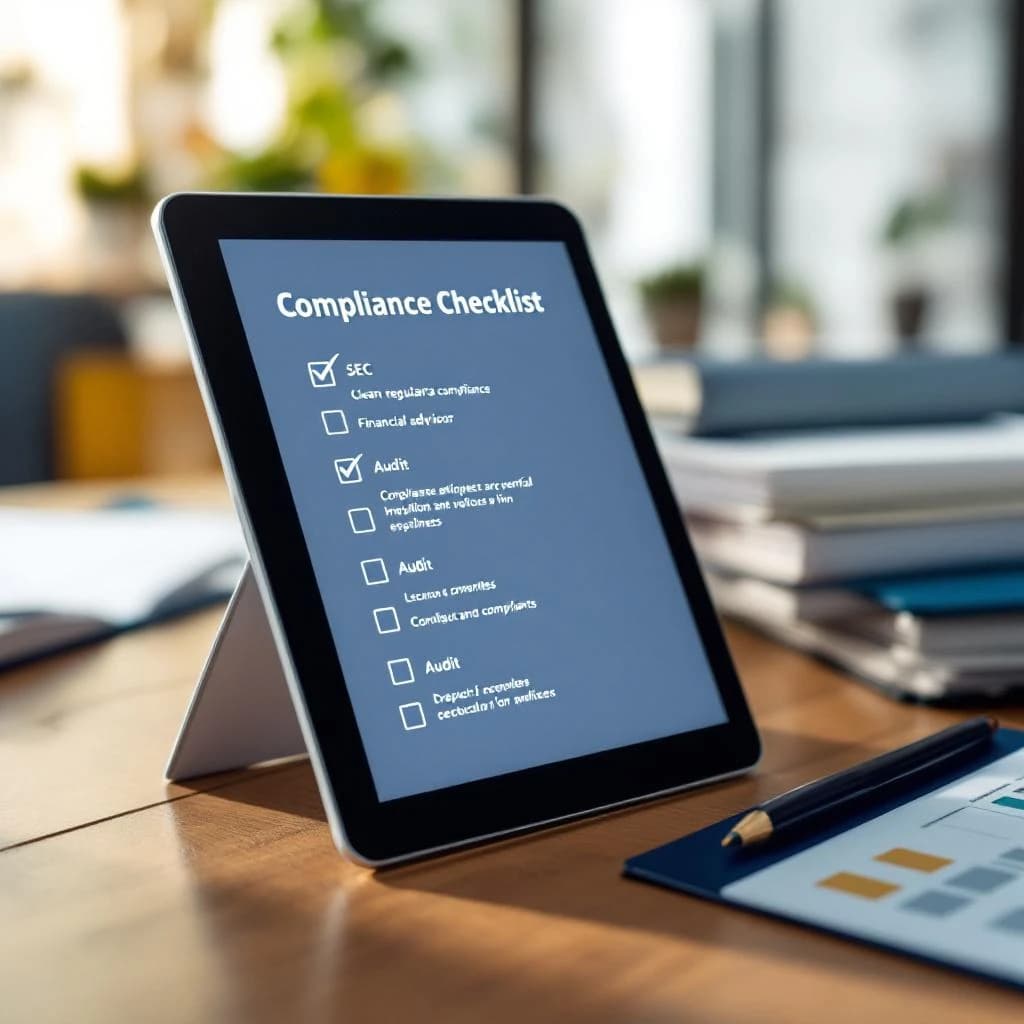
The CCO Checklist for Evaluating Any Advisor-AI Vendor
Before you sign a contract with an advisor-AI vendor, your CCO or compliance consultant should ask these eight questions. If the vendor can't answer them clearly, you're looking at a compliance retrofit project, not a compliance-ready tool.
Does the tool log every AI interaction with a timestamp and user attribution?
You need to know who prompted the AI, when, and what the output was. If the tool doesn't log this automatically, you're relying on manual documentation, which fails under pressure.
Can you export a complete audit trail for third-party review?
Ask the vendor to show you a sample export. It should include user IDs, timestamps, AI prompts, AI outputs, human edits, and approval records. If the export is incomplete or requires manual assembly, it's not audit-grade.
Does the tool enforce human review before client-facing content is delivered?
This is the difference between a gate and a suggestion. A gate won't let you send an email until a supervisor approves it. A suggestion reminds you to review but doesn't stop you from skipping it.
How does the tool handle version control for AI-generated content?
If the AI drafts an email and you edit it three times, can you see all three versions? Can you show which parts were AI-generated and which were human-edited? If not, you can't reconstruct what was supervised.
What happens to data if you terminate the contract?
Books and records requirements don't end when your subscription ends. Ask how long the vendor retains your data post-termination and whether you can export a complete archive. Some vendors delete data after 90 days, which creates a compliance gap if you're subject to multi-year retention requirements.
Does the vendor's SOC 2 report cover AI-specific controls?
A SOC 2 Type II report is good, but most of them cover infrastructure security, not AI supervision workflows. Ask to see the control objectives. If they don't mention AI output logging, version control, or supervisory review, the SOC 2 doesn't cover the compliance risk you care about.
Can the tool integrate with your existing compliance and CRM systems?
If the AI tool operates in a silo, you'll end up with fragmented records. Ask whether the tool can push audit logs to your compliance archive or sync with your CRM's activity tracking. Integration gaps create manual work that doesn't scale.
What's the vendor's process for responding to regulatory inquiries?
If the SEC or a state regulator issues a subpoena or exam request that includes records from the AI tool, how fast can the vendor produce them? Ask for a documented process and a target response time. Some vendors treat this as a custom services request with a separate fee, which is a problem when you're under exam pressure.
Books and Records Compliance for Advisor AI: What Survives an Exam
SEC Rule 204-2 requires RIAs to maintain records of all communications with clients and all documents supporting investment advice. If your AI tool drafts an email, generates a plan, or summarizes a meeting, those outputs are records. You need to retain them in a format that's accessible for regulatory review.
The common mistake is assuming that the vendor's cloud storage satisfies your retention obligation. It doesn't. You need to ensure that records are preserved even if the vendor goes out of business, you switch platforms, or the vendor's retention policy is shorter than your regulatory requirement.
For most RIAs, that means exporting AI-generated records to your own compliance archive on at least a quarterly basis. One $150M RIA I worked with automated this with a scheduled export from Jump to their document management system. The export runs every 90 days and creates a timestamped, immutable archive. That's the standard.
If your AI vendor doesn't support automated exports, you're stuck with manual downloads, which don't happen consistently. That's a books and records violation waiting to surface.
How Much Does AI Consulting Cost for Wealth Firms Evaluating These Tools?
If you're evaluating advisor-AI tools and need help distinguishing marketing-grade from audit-grade compliance, expect to pay $8,000 to $18,000 for a structured vendor review and compliance gap analysis. That includes tool demos, audit trail testing, policy template review, and a written recommendation you can take to your board or compliance committee.
For firms that have already selected a tool and need help retrofitting supervision workflows, implementation consulting typically runs $12,000 to $30,000 depending on firm size and complexity. The cost is lower if the tool you selected has audit-grade compliance built in. It's higher if you're trying to make a marketing-grade tool exam-ready.
Look, most compliance failures with advisor AI are preventable. They happen because firms treat compliance as a checkbox during the buying process instead of the primary selection criterion. If your CCO can't explain how the tool satisfies supervision and books-and-records requirements, you're not ready to deploy it. Fix that before the exam notice arrives, not after.
Get a free AI-powered SEO audit of your site
We'll crawl your site, benchmark your local pack, and hand you a prioritized fix list in minutes. No call required.
Run my free audit