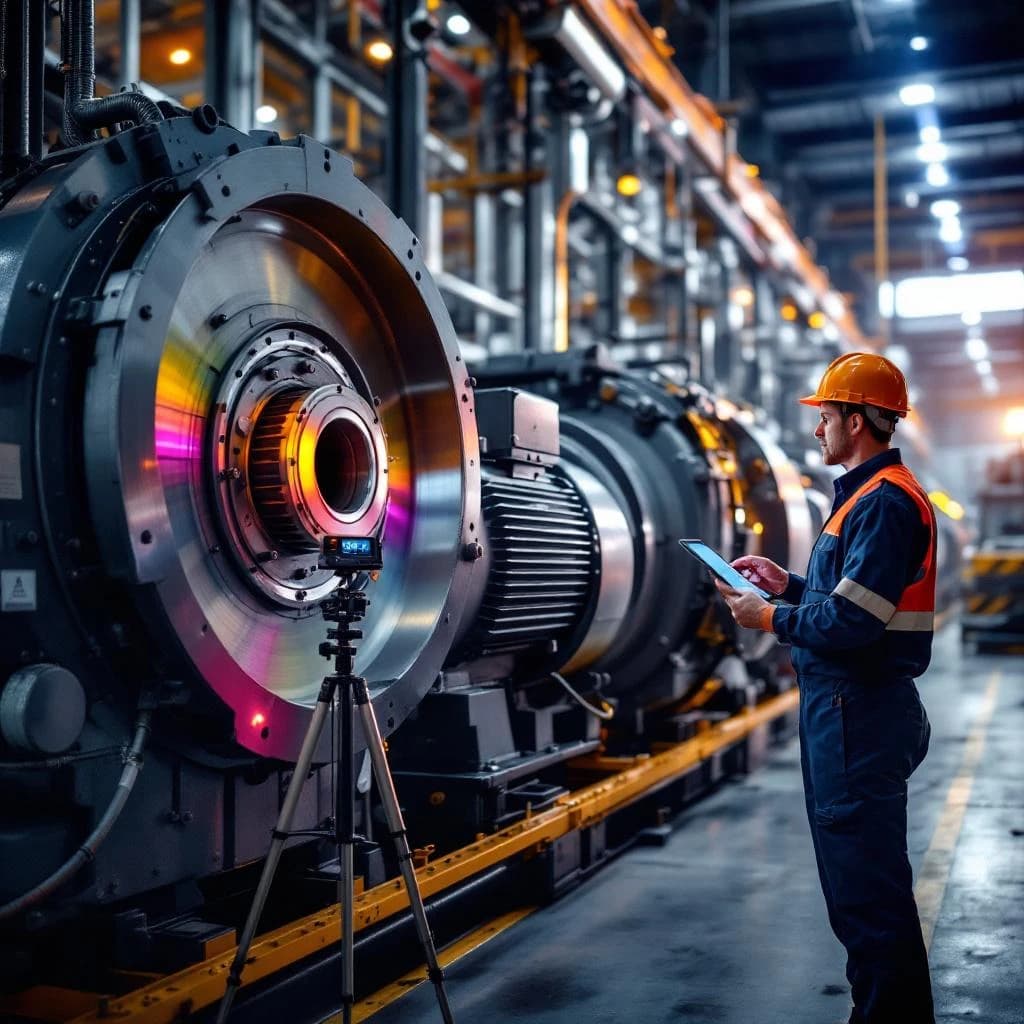
AI predictive maintenance works by collecting real-time data from multiple sensor types installed on critical equipment, feeding that data into a trained model that recognizes patterns associated with impending failure, and generating prioritized maintenance alerts before breakdowns occur. The system combines vibration sensors, thermal cameras, and acoustic monitors to detect early signs of wear, then uses sensor fusion algorithms to weigh conflicting signals and produce a confidence score that tells your maintenance team which assets need attention and when. The prediction then flows into your CMMS as a work order, where your maintenance lead decides whether to act based on production schedules, parts availability, crew capacity, and honestly a dozen other factors only they understand.
What AI Predictive Maintenance Actually Does
AI predictive maintenance is a condition-based monitoring system that watches equipment for signs of degradation and predicts when a component will fail. Unlike preventive maintenance, which replaces parts on a fixed calendar schedule, predictive systems respond to actual equipment condition. You're not changing a bearing every 5,000 hours whether it needs it or not. You're changing it when sensor data says it's about to fail.
The AI component processes streams of sensor data and identifies patterns humans can't see across thousands of data points. A vibration spike alone might be nothing. A temperature increase alone might be normal load variation. But when vibration rises 15% while temperature climbs 8°C and a new 4kHz acoustic signature appears, the model recognizes that combination as early bearing failure and generates an alert. Pattern recognition at scale.
Most deployments focus on rotating equipment: motors, pumps, compressors, conveyors. These assets have well-understood failure modes and generate clear sensor signals. A typical mid-market manufacturer might monitor 20 to 50 critical assets, not every motor on the floor. You don't need to instrument everything.
The Three Sensor Streams That Feed the System
Vibration sensors catch bearing wear, shaft misalignment, imbalance, and a bunch of other mechanical issues. Accelerometers mounted on motor housings or pump casings measure frequency and amplitude. Normal equipment has a baseline vibration signature. As bearings degrade, you'll see rising amplitude at specific frequencies tied to bearing geometry. A skilled vibration analyst can read an FFT spectrum and diagnose the problem, but the AI model does this continuously across dozens of assets.
Thermal cameras spot overheating before failure. Infrared sensors measure surface temperature on motor windings, electrical connections, bearing housings. A 20°C rise above baseline on a motor bearing housing usually means lubrication breakdown or excessive load. Thermal data alone has high false positive rates because ambient temperature, load variation, and airflow all affect readings, but it's a strong signal when combined with other inputs.
Acoustic sensors detect abnormal friction, cavitation, leaks. Ultrasonic microphones pick up high-frequency sounds humans can't hear. Cavitation in a pump produces a distinct acoustic signature in the 20-40kHz range. A degrading gear tooth creates impact noise at mesh frequency. Compressed air leaks generate turbulent flow noise. Acoustic data is noisy and context-dependent, which is why it works best as part of a sensor fusion approach rather than a standalone diagnostic.
How Sensor Fusion Turns Weak Signals Into Action
Sensor fusion is the process of combining data from multiple sources to produce a more reliable prediction than any single sensor could provide. Each sensor type has blind spots. False triggers too. Vibration spikes during startups. Temperature varies with ambient conditions. Acoustic signatures change with background noise. The AI model learns which combinations matter.
Here's a concrete example: a centrifugal pump shows normal temperature, rising vibration at 2x running speed, and a new acoustic signature at 8kHz. Individually, none of these crosses an alarm threshold. Together, they match the model's learned pattern for impeller imbalance. The system generates an alert with an 87% confidence score and a recommended action: inspect impeller for debris or wear within the next 72 hours.
The model assigns a confidence score based on how closely current sensor readings match historical failure patterns. A score above 80% typically triggers a work order. Scores between 60-80% might generate a watchlist item. Below 60%, the system logs the data but doesn't alert. These thresholds are configurable, and you'll tune them during your pilot based on your tolerance for false positives versus missed failures.
Most systems I've seen operate with a 15-25% false positive rate after tuning, meaning one in five or six alerts doesn't correspond to actual equipment degradation. That's acceptable if the alternative is an unplanned shutdown that costs $50,000 per hour. Your maintenance lead learns to interpret confidence scores and correlate them with other plant knowledge. It's part science, part art.
The Work Order Workflow Nobody Explains
The prediction doesn't fix the equipment. It creates a work order in your CMMS, and that handoff determines whether the system saves time or creates friction. This integration is where most pilots fail, not because the AI is wrong but because the workflow wasn't designed.
Auto-Generated Work Orders and Approval Gates
When the model generates an alert above your confidence threshold, it creates a draft work order with asset ID, predicted failure mode, recommended action, urgency level. Some systems integrate directly with CMMS platforms like IBM Maximo, SAP PM, or Fiix. Others use API connections or manual CSV exports. Direct integration is worth paying for because it eliminates data entry and reduces response time from hours to minutes.
You'll configure approval rules based on confidence score and asset criticality. High-confidence alerts (above 85%) on critical assets might auto-approve and assign to a technician. Medium-confidence alerts (70-85%) route to a maintenance planner for review. Low-confidence alerts go into a watchlist that gets reviewed weekly. These rules prevent alert fatigue and keep your team focused on genuine issues.
Where the Maintenance Lead Still Owns the Call
The model proposes, the human approves. Your maintenance lead evaluates each alert against production schedules, spare parts inventory, crew availability. If the model says a motor bearing needs replacement but you don't have the part in stock and the line is running a critical order, you might defer the work and increase monitoring frequency. This isn't a system failure. It's operational judgment the AI can't replicate.
I've watched companies try to eliminate this human step and regret it. Auto-approving every alert sounds efficient until you shut down a production line for a false positive during peak season. The right design treats the AI as a highly attentive junior technician who spots problems early but doesn't make scheduling decisions. That's still your maintenance lead's job.
Predictive vs Preventive Maintenance Economics
Preventive maintenance replaces components on a fixed schedule regardless of condition. You change a bearing every 5,000 operating hours even if it has 2,000 hours of life remaining. This approach is simple to plan but wastes parts and labor. Typical preventive programs achieve 70-80% equipment availability and carry a 20-30% waste rate on parts replaced prematurely.
Predictive maintenance replaces components based on condition, extending useful life and reducing unplanned downtime. A well-tuned system can push equipment availability to 85-92% while cutting parts spend by 15-25%. The tradeoff is upfront sensor cost, software subscriptions, the effort to tune the system. For high-value assets where an hour of downtime costs $20,000 or more, the economics work clearly. For low-cost equipment with cheap replacement parts, preventive maintenance often makes more sense.
The break-even calculation is straightforward: (annual avoided downtime cost + parts waste savings) minus (sensor hardware + software subscription + integration labor). If that number is positive in year two, the project pencils. Most pilots I've scoped target a 12-18 month payback on a single high-value asset, then expand to additional equipment once the workflow is proven.
The 90-Day Pilot That Proves ROI
Start with one high-value asset that has known failure history. A motor that's failed twice in the past year. A pump with chronic bearing issues. A conveyor that stops production when it goes down. You want an asset where failure is costly, somewhat predictable, instrumentable without major modifications.
Instrumentation and Baseline Collection
Install vibration sensors, thermal monitoring, acoustic pickups on the target asset. Wireless sensors cost $300-$800 per monitoring point. Wired sensors run $150-$400 but require installation labor. Budget $2,000-$5,000 for a single critical asset with three sensor types. Collect baseline data for 2-4 weeks under normal operating conditions so the model learns what "healthy" looks like.
Your lead technician should review the baseline data and confirm it matches their understanding of normal operation. If the vibration spectrum shows anomalies during baseline collection, you've already found a problem before the AI even starts predicting. This happens more often than you'd expect, and honestly most teams skip this validation step.
Threshold Tuning and Alert Validation
Set the initial alert threshold at 75% confidence and adjust based on results. Too many false positives? Raise the threshold to 80% or 85%. Missing real issues? Lower it to 70% and accept more review work. Track every alert: was it a true positive, false positive, or inconclusive? After 60-90 days, you'll have enough data to measure precision (what percentage of alerts were real) and recall (what percentage of actual failures were caught).
A good pilot targets 70% precision and 80% recall, meaning seven out of ten alerts correspond to real issues, and the system catches eight out of ten actual failures before they cause unplanned downtime. These numbers improve as the model trains on more data from your specific equipment and operating conditions. Give it time.
Measuring Avoided Downtime Against System Cost
Document every alert that led to planned maintenance and estimate the downtime you avoided. If the system caught a bearing issue that would have caused a 4-hour unplanned shutdown, and your downtime cost is $30,000 per hour, you avoided $120,000 in lost production. Compare that to the $8,000 in sensor hardware, $12,000 in software subscription, $15,000 in integration labor. One avoided failure pays for the pilot.
The math gets compelling fast for high-value assets. For lower-value equipment, you'll need to catch multiple failures or extend the payback window. This is why starting with your most expensive failure modes matters. If you're considering a broader rollout, the detailed economics are covered in how much AI costs for manufacturing companies.
What Actually Breaks These Projects
Integration friction kills more pilots than bad predictions. The AI vendor delivers a dashboard with beautiful visualizations, but nobody built the API connection to your CMMS, so alerts sit in a separate system your techs don't check. Or the work order format doesn't match your existing process, so maintenance planners spend 20 minutes reformatting each ticket. This is the same workflow breakdown that causes manufacturing AI vision projects to fail in production.
Unrealistic expectations are the second killer. Leadership expects the system to eliminate all unplanned downtime in month one. It won't. You'll catch 60-70% of failures in the first six months, rising to 80-85% after a year of training data. Some failure modes happen too fast for prediction: a catastrophic bearing seizure from contamination might go from healthy to failed in hours, faster than your monitoring interval. Physics doesn't care about your prediction model.
Lack of ownership is the third. Someone needs to own alert review, threshold tuning, CMMS integration. If that responsibility is unclear or falls to someone already underwater, the system generates alerts nobody acts on, and six months later leadership concludes "AI doesn't work." It works when someone is accountable for making it work.
What to Ask Vendors Before You Buy
Ask for the false positive rate in similar deployments. If they won't give you a number, walk away. Expect 15-25% after tuning. Anything below 10% probably means the threshold is set so high you're missing real failures. Ask how alerts integrate with your specific CMMS. "We have an API" isn't enough. You want to see the actual work order format and approval workflow.
Ask what happens when the model is wrong. How do you flag false positives so the system learns? How often does the model retrain on new data? Monthly retraining is standard, quarterly is acceptable, anything less frequent means the system won't adapt to your operating conditions. Ask who owns threshold tuning. If the vendor expects you to do it without training or support, budget extra time and internal expertise.
Look, ask for pilot success criteria in writing. What precision and recall targets are they committing to? What does "success" look like at 90 days? If they won't define measurable outcomes, they're not confident in the technology or they're planning to move the goalposts later. Either way, that's a red flag.
AI predictive maintenance works when you treat it as a decision support tool that extends your maintenance team's reach, not a replacement for human judgment. The system watches equipment continuously and spots patterns your team would miss, but your maintenance lead still decides when to act based on operational context the AI can't see. Start with one high-value asset, prove the avoided downtime exceeds the system cost, then expand methodically. The technology is real. The ROI is measurable. And the workflow integration is where you'll earn or lose the value.
Get a free AI-powered SEO audit of your site
We'll crawl your site, benchmark your local pack, and hand you a prioritized fix list in minutes. No call required.
Run my free audit