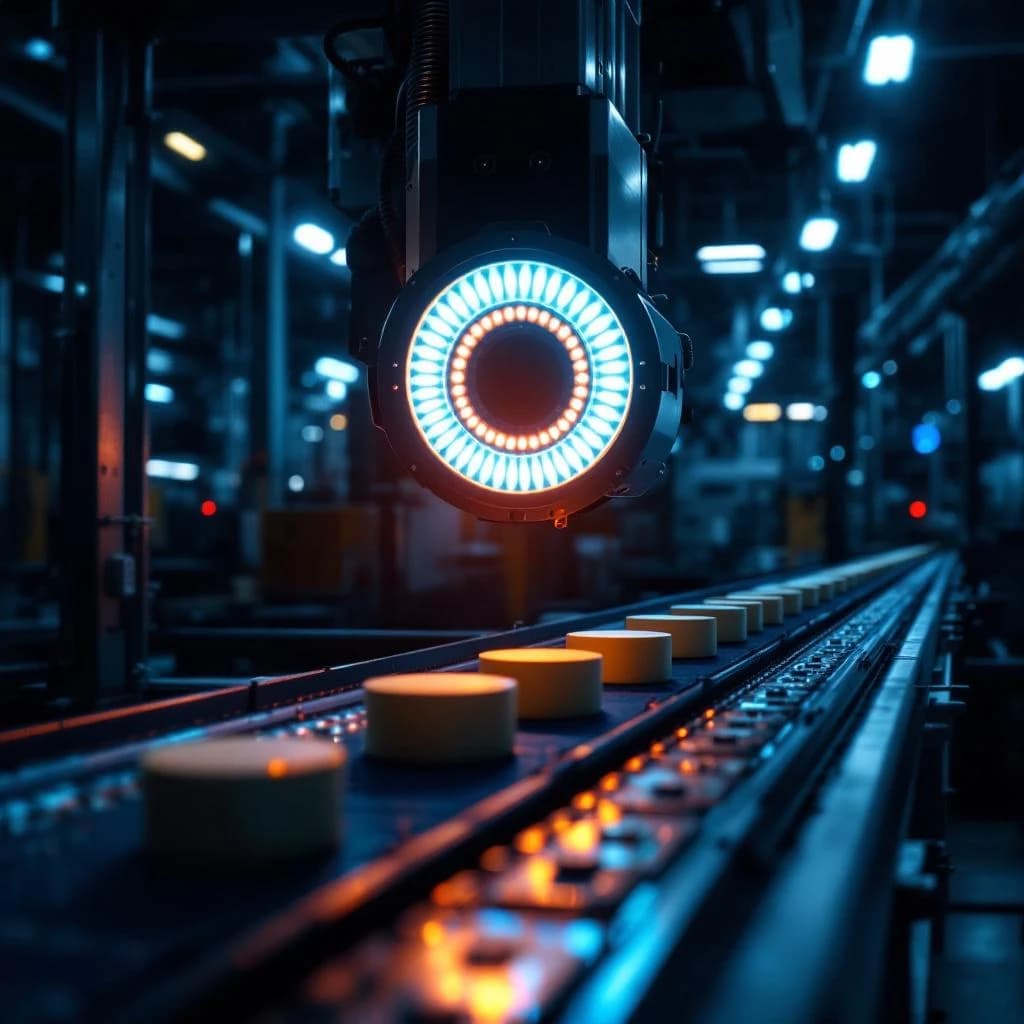
Manufacturing AI vision projects fail in production because the controlled conditions that produced an 80% accuracy demo vanish the moment you hit night shift, switch suppliers, or encounter the low-volume SKU nobody included in the training set. The lighting changes, the labels drift, and the retraining loop that should catch these problems never gets staffed or budgeted after go-live. You're left with a model that worked beautifully in the vendor's lab and fails silently on your line at 2am.
This isn't a technology problem. It's a scoping and contract problem that plants discover six months too late.
What Kills Manufacturing AI Vision Projects After Deployment
The failure modes cluster around environmental variance the vendor never tested, data drift no one monitors, operational handoffs that don't survive contact with shift schedules, and honestly, a whole lot of wishful thinking. Each one is predictable, measurable, and almost never addressed in the statement of work.
Start with lighting. A vision system trained under consistent LED lighting at 5000K color temperature will degrade when you move to fluorescent fixtures that flicker at 120Hz or when natural light from skylights shifts the color balance by 1500K between morning and afternoon. Shadow angles change between first and third shift. Reflective surfaces on packaging behave differently under different spectra. The model doesn't know it's confused, it just starts misclassifying at a rate that creeps from 5% to 18% over three months.
One automotive tier-two supplier we worked with saw their weld inspection accuracy drop from 91% to 74% when they switched from day shift commissioning to 24/7 production. The vendor had done all testing between 9am and 3pm under natural + LED light. Night shift ran under sodium vapor. The contract had no accuracy floor by lighting condition.
Why Label Drift Destroys Model Accuracy Silently
Label drift is the silent killer. Your supplier changes ink batches, substrate thickness, or print registration by 0.3mm. Humans don't notice. The vision model, trained on 10,000 images of the old labels, starts throwing false positives because the text is now 2 pixels left of where it expects.
This happens constantly in food and pharma. A packaging supplier switches from one flexographic press to another. The color density changes by 8%. The model was trained on the old density. Accuracy drops from 87% to 68% over two production runs, and no alarm fires because the system doesn't know what it doesn't know.
We've seen this kill projects that cost $240K to deploy. The plant budgeted for hardware, integration, and training. They didn't budget for the data ops team to continuously monitor inference confidence scores, flag distributional drift, and trigger retraining workflows. That's another $6K to $11K per month in labor and compute if you're running it properly.
Roughly 60% of vision deployments we audit have no automated drift detection in production. They rely on operators noticing that reject rates are climbing, which means you're flying blind until the problem is acute.
The Retraining Loop Nobody Staffs or Funds
Retraining isn't a one-time cost. It's an operational expense that recurs every time your production environment changes, and it changes more often than you think. New SKU? Retrain. Seasonal packaging? Retrain. Supplier switch? Retrain. Equipment upgrade that changes camera angle by 4 degrees? You guessed it.
Each retraining cycle costs between $8K and $35K depending on dataset size, labeling complexity, and whether you're using transfer learning or starting from scratch. If you're running a high-mix facility with 200+ SKUs and seasonal variants, you could be looking at four to seven retraining events per year. That's $32K to $245K annually that never appears in the vendor's ROI slide deck.
Who owns this work? The vendor's SOW usually covers initial training and maybe one post-deployment update. After that, it's on you. Do you have a data scientist on staff who knows how to retrain a YOLOv8 model, tune hyperparameters, and validate against your specific defect taxonomy? If not, you're paying the vendor's hourly rate, which runs $180 to $320 per hour for vision ML work.
The plants that survive this phase have either built an internal ML ops capability or negotiated a retaining contract with caps. The ones that fail assumed the model would just keep working.
What a Retraining SLA Should Actually Cover
Your contract needs to specify turnaround time, accuracy recovery targets, and cost caps per retraining event. A good SLA says: "Vendor will retrain model to restore accuracy to within 3 percentage points of baseline within 10 business days of drift detection, at a fixed cost of $12K per event, capped at three events per year included in annual maintenance."
Without that language, you're negotiating every retraining event from scratch while your line is down. We've seen vendors quote $50K for emergency retraining because the contract didn't define it as a covered service. You can't afford to discover this at 3am when the line stops.
Edge Cases and Low-Volume SKUs That Break the Model
Vision vendors train on your high-runners because that's where the data is. If you produce 10 million units of SKU A and 5,000 units of SKU B per year, the model gets 10,000 images of A and maybe 40 images of B. It will confidently misclassify B at a 30% to 50% rate because it's never seen enough examples to learn the defect patterns.
This is worse for rare but critical defects. A cosmetic scratch on a consumer product might appear once in every 2,000 units. A structural crack in a medical device might appear once in 50,000. If your training set has three examples of the critical defect, the model will miss it in production. It doesn't have the statistical power to generalize.
Seasonal packaging changes destroy models trained on a single variant. A beverage company we consulted for ran a summer label promotion. The vision system, trained on the standard label, flagged 40% of the promotional units as defective because the color palette was outside the training distribution. They had to manually override the system for six weeks while they scrambled to retrain.
Ask the vendor: what's your accuracy on SKUs with fewer than 500 production examples per year? What's your false negative rate on defects that appear fewer than 100 times in the training set? If they can't answer with data, they haven't tested it.
Why Vendor Demos Look Perfect and Production Doesn't
Demo theater is real. The vendor brings a cart with controlled lighting, a curated set of parts, and a laptop running inference on a GPU that costs $4K. They show you 95% accuracy on a dataset they selected. Then you deploy on your line with your lighting, your parts, your camera mounts, and an edge device that costs $1,200 because that's what the capex budget allowed.
The performance delta between demo and production averages 12 to 22 percentage points in the vision projects we've autopsied. The demo ran on an NVIDIA A4000. Production runs on a Jetson Xavier. The demo used 4K images. Production uses 1080p because that's what the existing cameras output. The demo had perfect part placement. Production has positional variance of plus or minus 8mm because that's how the conveyor works.
Insist on a pilot that runs on your actual production line, with your actual lighting, during all shifts, for at least 200 hours of runtime. Anything less is vendor selection theater. You need to see performance under fluorescent flicker, under shadow variance, under the positional jitter your conveyor introduces, and with the image resolution your existing infrastructure supports.
If the vendor won't commit to a pilot on your line, they don't believe their system will hit the accuracy target in your environment. That's the tell.
Contract Clauses That Protect the Plant When Vision Fails
Your contract is your only defense when the model degrades and the vendor wants to renegotiate scope. You need accuracy SLAs with financial teeth, retraining cost caps, liability for line downtime, and a termination right if accuracy falls below threshold. Four things, not three.
An accuracy SLA should specify minimum performance by shift, by SKU category, and by defect type. "System will maintain 89% true positive rate and 4% false positive rate on high-volume SKUs during all production shifts, measured over rolling 7-day windows." If the vendor misses that target for two consecutive measurement periods, you get a service credit equal to 15% of the monthly fee. If they miss for four periods, you can terminate without penalty.
Retraining cost caps prevent surprise bills. "Vendor will provide up to four model retraining events per year at no additional cost, triggered by accuracy degradation below SLA or introduction of new SKU variants. Additional retraining events will be billed at $9,500 per event, not to exceed $28,500 annually."
Liability for line downtime matters when the vision system is in the critical path. If a false positive stops the line, who pays for the lost production? Standard vendor contracts limit liability to the fees paid. That's unacceptable when an hour of downtime costs you $18K in lost output. Negotiate a carve-out: "Vendor liability for line downtime caused by system false positives or failures shall not be subject to the general limitation of liability and shall be capped at $150K per incident."
These clauses won't make it into the vendor's standard MSA. You'll have to red-line them in. If the vendor refuses, they're not confident the system will perform. For more on how to structure these conversations and what typical AI project costs look like in manufacturing, see how much AI costs for manufacturing companies in 2026.
How to Audit a Vision Vendor Before You Sign
Run a technical diligence process that most plants skip. Ask for access to their model cards: what architecture, what training dataset size, what validation methodology, what edge hardware specs. If they won't share, walk.
Request a reference call with a customer running a similar SKU mix, similar production volume, and similar lighting conditions. Not their best customer. A customer who's been live for 18+ months and has been through at least two retraining cycles. Ask that customer: what surprised you after go-live? How many retraining events have you done? What does it actually cost to operate this system?
Test their monitoring and alerting. How does the system detect when accuracy is degrading? What metrics does it track? Inference confidence, distributional drift, false positive rate by SKU, true positive rate by defect type? If they don't have automated drift detection, you're going to discover problems only when operators start complaining.
Validate their edge deployment story. What happens when the network connection to the cloud drops? Does inference keep running locally? How do you push model updates to edge devices? What's the rollback procedure if a new model performs worse than the old one? These operational details kill projects that had solid ML engineering but no deployment ops plan.
Finally, pressure-test the retraining workflow. Who labels new data? What's the labeling cost per image? How long does a retraining cycle take from data collection to model deployment? If the answer is "we'll figure that out after go-live," the project will fail when you need your first update and discover it takes six weeks and costs $40K.
What Actually Works in Manufacturing Vision Deployments
The projects that survive past year one have things in common: they piloted on the actual line for 300+ hours across all shifts, they budgeted $80K to $140K annually for retraining and model ops, and they built internal capability to label data and validate model updates. Just those things.
They also started with a narrow scope. One defect type, one SKU family, one production line. They proved the system could maintain 85%+ accuracy for six months under real conditions before they expanded. The failures tried to boil the ocean: ten defect types, 50 SKUs, three lines, all at once. Complexity kills.
Look, if you're evaluating a vision project, the questions that matter are: what's your retraining budget for years two and three? Who on your team can validate model performance and flag drift? What's your accuracy floor, and what happens contractually when the vendor misses it? If you don't have answers, you're not ready to deploy.
Vision QC is solvable, but it's an operational system that requires ongoing investment, not a one-time capital project. Vendors who pretend otherwise are selling you a demo, not a production system. The difference shows up at 3am when the line is down and the contract says retraining is out of scope. For more on how to structure AI projects to avoid similar pilot failures, see how to automate repetitive tasks in small business with AI for principles that apply across use cases.
Treat vision like you'd treat any other production equipment: with a maintenance budget, a performance SLA, and a vendor contract that aligns incentives. Anything less is a $200K gamble that the environment won't change and the model won't drift. You already know how that bet ends.
Get a free AI-powered SEO audit of your site
We'll crawl your site, benchmark your local pack, and hand you a prioritized fix list in minutes. No call required.
Run my free audit