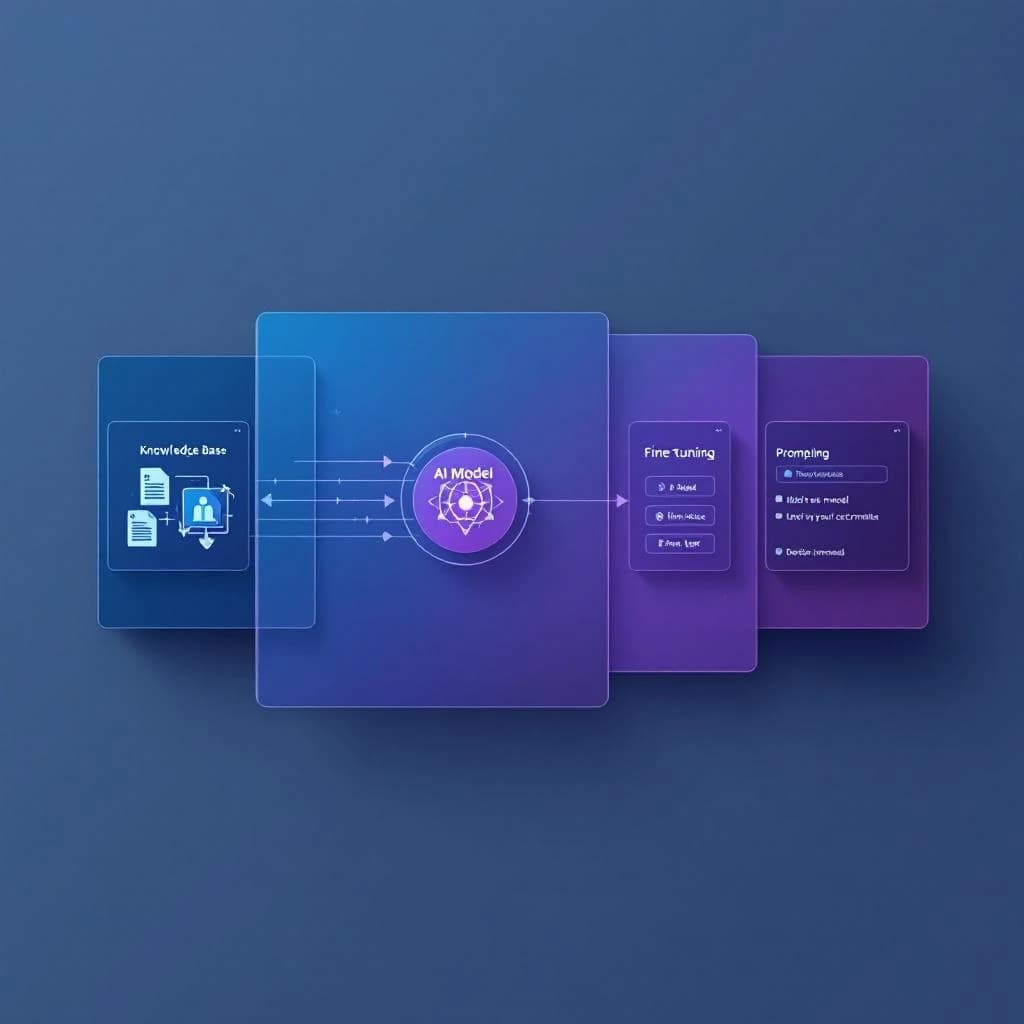
When you're building an AI application, the decision between RAG, fine-tuning, and prompt engineering comes down to one simple question: are you solving a knowledge problem or a behavior problem? If your model doesn't know specific facts or can't access certain data, you need RAG. If it has the knowledge but responds incorrectly or in the wrong tone, you need fine-tuning. But before either of those, you should always start with prompt engineering because it's the fastest and cheapest option. Production systems typically use all three techniques together, each handling its specific role.
What's the Difference Between RAG and Fine-Tuning for LLMs?
RAG (Retrieval Augmented Generation) and fine-tuning solve fundamentally different problems. RAG gives your model access to external knowledge by retrieving relevant documents or data at query time and including them in the prompt context. Fine-tuning modifies the model's weights through additional training to change how it behaves or responds.
Think of RAG as giving someone a reference book to consult, while fine-tuning is like teaching them a new skill through practice. RAG doesn't change the model itself, it just provides additional context. Fine-tuning actually alters the model's internal parameters.
The cost difference is significant. RAG typically adds $0.01 to $0.05 per query for vector database lookups and increased token usage, while fine-tuning can cost $50 to $500+ per training run depending on model size and dataset. For applications handling 10,000 queries per month, that's $100-500 ongoing for RAG versus a one-time fine-tuning cost that may need repeating when you update your training data.
When to Use Retrieval Augmented Generation vs Fine-Tuning
Use RAG when you're solving a knowledge problem. Your model needs access to information it wasn't trained on: your company's internal documentation, real-time data, customer records, or domain-specific content. RAG excels when the information changes frequently or when you need to cite sources.
Common RAG use cases include customer support bots that need product documentation, legal assistants that reference case law, or any application querying proprietary databases. If you can solve the problem by showing the model the right information, RAG is your answer.
Use fine-tuning when you're solving a behavior problem. The model already has the knowledge but responds in the wrong format, uses incorrect reasoning patterns, or doesn't match your required tone. Fine-tuning is for teaching the model how to respond, not what to know.
Typical fine-tuning scenarios include making a model output structured JSON consistently, adopting a specific brand voice, or mimicking expert decision-making processes. You're training the model to behave differently, not to remember new facts.
How to Choose Between Prompting, RAG, and Fine-Tuning
Always start with prompt engineering. Roughly 60-70% of problems that seem to require RAG or fine-tuning can be solved with better prompting. Test few-shot examples, chain-of-thought reasoning, and structured output formats before building infrastructure.
Here's your decision framework as a flowchart in your mind: Can prompting solve it? If yes, stop there. If no, ask: does the model lack specific information? If yes, add RAG. If the model has the information but responds incorrectly, consider fine-tuning.
Step 1: Test Prompting First
Spend 2-3 hours experimenting with prompt variations before moving to more complex solutions. Try zero-shot prompting with clear instructions, then few-shot examples showing desired behavior. Use system messages to set context and constraints.
For structured outputs, specify the exact format in your prompt. For tone issues, include examples of the desired voice. For reasoning problems, add explicit step-by-step instructions. You'd be surprised how many "complex" problems dissolve with a well-crafted 300-word prompt.
Step 2: Add RAG for Knowledge Gaps
If prompting fails because the model doesn't have access to specific information, implement RAG. Start with a vector database like Pinecone, Weaviate, or Chroma. Chunk your documents into 200-500 token segments, create embeddings, and retrieve the top 3-5 most relevant chunks per query.
A basic RAG pipeline looks like this:
from openai import OpenAI
import chromadb

client = OpenAI()
db = chromadb.Client()
collection = db.get_or_create_collection("docs")

# Retrieve relevant context
results = collection.query(
    query_texts=[user_question],
    n_results=3
)

# Build prompt with context
context = "\n".join(results['documents'][0])
prompt = f"Context:\n{context}\n\nQuestion: {user_question}\nAnswer:"

# Generate response
response = client.chat.completions.create(
    model="gpt-4",
    messages=[{"role": "user", "content": prompt}]
)
Monitor your retrieval quality. If the right documents aren't in your top results more than 80% of the time, adjust your chunking strategy or embedding model before blaming the LLM. Testing your retrieval system separately from generation is critical, and you can read more about validation approaches in how to test AI models before deploying to production.
Step 3: Fine-Tune for Behavior Changes
If the model has the knowledge but consistently responds incorrectly, prepare a fine-tuning dataset. You'll need 50-100 examples minimum for simple tasks, 500-1000+ for complex behavior changes. Each example should show the exact input-output pattern you want.
Format your training data as JSONL with clear demonstrations:
{"messages": [{"role": "system", "content": "You are a technical support agent. Always respond in three sections: Diagnosis, Solution, Prevention."}, {"role": "user", "content": "My app keeps crashing on startup."}, {"role": "assistant", "content": "Diagnosis: App crash on startup typically indicates corrupted cache or outdated dependencies.\n\nSolution: 1. Clear app cache in Settings > Apps. 2. Update to latest version. 3. Restart device.\n\nPrevention: Enable automatic updates and restart your device weekly."}]}
Fine-tuning GPT-3.5-turbo costs about $0.008 per 1K tokens for training and $0.012 per 1K tokens for inference. For a 100-example dataset averaging 500 tokens each, that's roughly $0.40 for training. GPT-4 fine-tuning is currently limited but expect 5-10x higher costs when generally available.
AI Engineering Interview Questions: RAG Fine-Tuning
This framework is a common interview question for AI engineering roles. Interviewers want to see if you understand the practical distinctions, not just theoretical differences. The best answer demonstrates the knowledge vs behavior heuristic and mentions cost considerations.
Strong candidates explain that production systems use all three techniques together. They might describe a customer service bot that uses prompting for conversation flow, RAG to retrieve relevant help articles, and fine-tuning to match company tone and format requirements. That's the reality of deployed LLM applications.
When asked "RAG vs fine-tuning, which one should I use?" the correct answer is "it depends on whether I'm solving a knowledge or behavior problem, but I'd start with prompting first." This shows you understand cost efficiency and won't over-engineer solutions.
Interviewers also test whether you know the limitations. RAG can't teach new reasoning patterns, and fine-tuning won't help if the model needs access to a database. Being clear about what each technique can't do is as important as knowing what it can do.
Production LLM Architecture: Using All Three Together
Real production systems combine prompting, RAG, and fine-tuning strategically. Your base prompt provides instructions and structure. RAG injects relevant knowledge. Fine-tuning ensures consistent behavior and format compliance.
Consider a legal document analyzer. The system prompt defines the task and output structure. RAG retrieves relevant case law and statutes from a vector database. Fine-tuning ensures the model consistently cites sources correctly and follows firm-specific formatting rules. Each technique handles its specific job.
Cost optimization matters at scale. If you're processing 100,000 queries monthly, reducing your average prompt length from 2,000 to 1,500 tokens saves roughly $1,500 per month on GPT-4 at current pricing. That's why you optimize prompts first, add RAG only where needed, and fine-tune only for behaviors you can't achieve otherwise.
The maintenance burden differs too. Prompts you can update instantly. RAG requires refreshing your vector database as documents change, usually a daily or weekly batch job. Fine-tuned models need retraining when you want behavior changes, which might be monthly or quarterly depending on your needs.
Common Mistakes When Choosing Between Approaches
The biggest mistake is fine-tuning when you should use RAG. Developers see poor answers about company-specific information and assume they need to fine-tune the model on their docs. But fine-tuning doesn't reliably encode factual knowledge, it teaches behavior patterns. You'll waste time and money on training runs that don't solve your problem.
The second mistake is building RAG infrastructure when better prompting would work. If your problem is that the model outputs JSON inconsistently, you don't need a vector database, you need a better-structured prompt with clear examples. Don't add complexity until you've exhausted simpler options.
Another common error is using RAG for reasoning tasks. If you need the model to follow a complex decision tree or apply multi-step logic, retrieving examples won't help as much as fine-tuning on demonstrations of the reasoning process. RAG provides facts, not cognitive patterns.
Look, many teams skip the hybrid approach. They treat these as mutually exclusive choices when production systems benefit from combining them. Your AI tools should use the simplest effective technique for each component of your application.
Cost and Complexity Considerations for Your Decision
Prompting costs only the tokens you send and receive. For GPT-4, that's $0.03 per 1K input tokens and $0.06 per 1K output tokens. A typical query with a 1,500-token prompt and 500-token response costs about $0.075. Zero infrastructure required.
RAG adds vector database costs and increased token usage. Pinecone's starter tier handles 100,000 vectors for $70/month. Chroma and Weaviate offer self-hosted options for free but require server costs. Your prompts get longer because you're including retrieved context, typically adding 500-1,500 tokens per query. Monthly costs for a moderate-scale RAG system run $200-800 depending on query volume.
Fine-tuning requires upfront training costs, dataset preparation time, and ongoing inference costs. Budget 10-40 hours for dataset creation and validation for your first fine-tuning project. Training itself takes minutes to hours depending on dataset size. The real cost is iteration, you'll likely need 3-5 training runs to get behavior right.
From a complexity standpoint, prompting requires no infrastructure. RAG needs vector database setup, document processing pipelines, and embedding generation. Fine-tuning requires dataset management, training infrastructure, and model versioning. Each step up adds operational overhead.
For teams wondering about the build vs buy decision for these capabilities, the cost crossover analysis typically favors managed services for RAG and fine-tuning until you're processing millions of queries monthly.
Quick Reference: Your Decision Tree
Here's your practical checklist for every AI application decision:
- Start with prompt engineering. Test for 2-3 hours with various prompt structures, examples, and instructions.
- If the model lacks specific information or data access, implement RAG. Choose this when you need real-time data, proprietary documents, or frequently changing information.
- If the model has knowledge but responds incorrectly, consider fine-tuning. Use this for consistent formatting, specific reasoning patterns, or tone requirements.
- In production, combine all three. Use prompting for structure, RAG for knowledge, and fine-tuning for behavior.
- Optimize in order of cost impact. Better prompts save money immediately, RAG optimization reduces ongoing costs, and fine-tuning reduces inference costs long-term.
The knowledge vs behavior distinction cuts through most confusion about these techniques. When you're building your next LLM application, ask yourself what problem you're actually solving. Most of the time, you'll find that starting simple with good prompts, adding RAG when you need external knowledge, and fine-tuning only for behavior changes will get you to production faster and cheaper than jumping straight to the most complex solution. Your users don't care which technique you used. They care that your application works reliably and responds correctly, and honestly, that's what matters.
Get a free AI-powered SEO audit of your site
We'll crawl your site, benchmark your local pack, and hand you a prioritized fix list in minutes. No call required.
Run my free audit