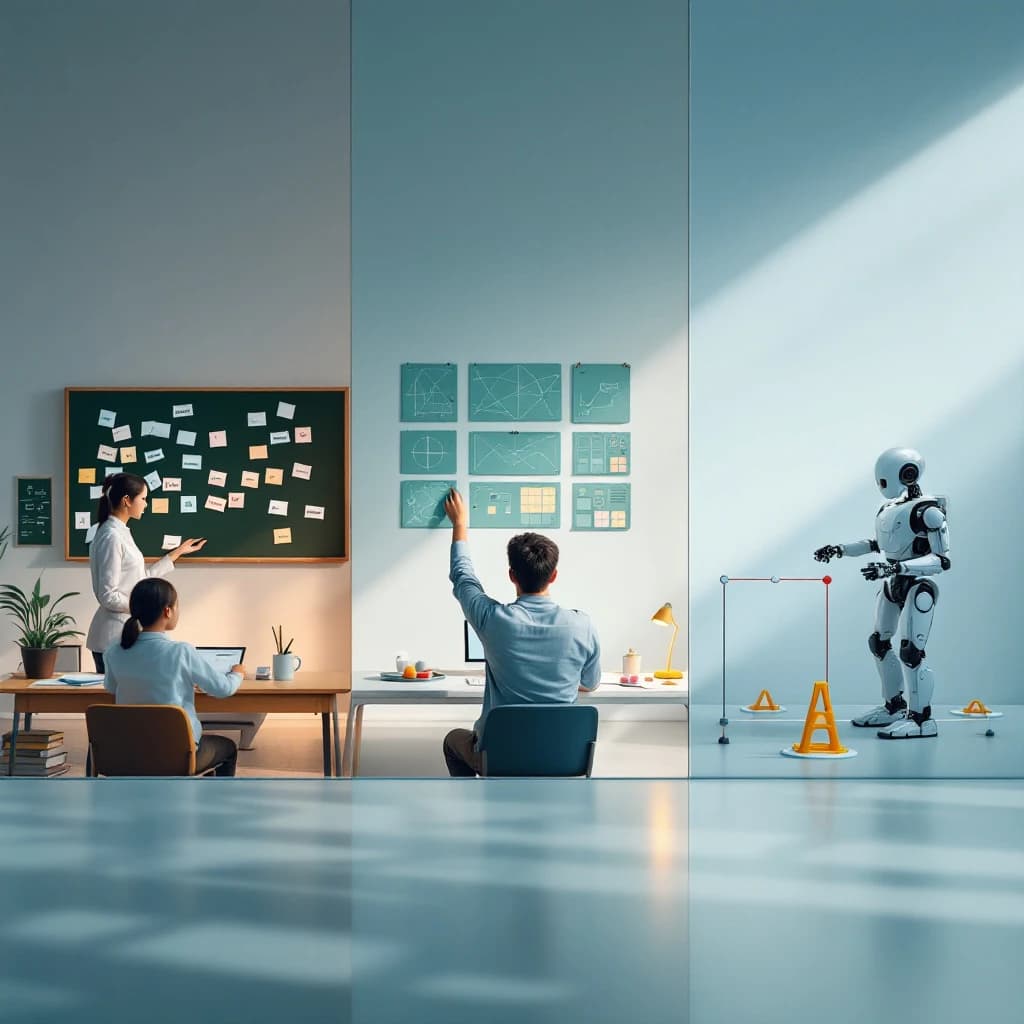
Machine learning splits into three core types: supervised learning (training with labeled examples), unsupervised learning (finding patterns in unlabeled data), and reinforcement learning (improving through trial and error). Supervised learning powers spam filters and image recognition by learning from tagged training data. Unsupervised learning drives recommendation engines and customer segmentation by discovering hidden patterns without guidance. Reinforcement learning enables game-playing AIs and robotics by optimizing decisions through feedback loops. You'll use supervised when you have labeled data and want predictions, unsupervised when you need to discover structure in raw data, and reinforcement when you're optimizing sequential decisions.
How Does Supervised Learning Work in AI
Supervised learning works exactly like studying with an answer key. You feed the algorithm input data paired with correct outputs, and it learns to map inputs to outputs. After seeing thousands of examples, the model can predict outputs for new, unseen inputs.
Here's a concrete example: training an email spam filter. You provide 10,000 emails, each labeled "spam" or "not spam." The algorithm analyzes features like sender address, subject line keywords, and link density. After training, it can classify new emails with roughly 95-98% accuracy on most modern systems.
The process breaks down into four steps. First, you collect labeled training data. Second, you choose an algorithm (decision trees, neural networks, support vector machines). Third, you train the model by showing it your labeled examples. Fourth, you test it on separate validation data to measure accuracy.
Supervised learning requires substantial labeled data. Image recognition models like those in Google Photos typically train on millions of tagged photos. Medical diagnosis systems need thousands of labeled patient records. This data requirement is the biggest limitation, since labeling data costs time and money.
Common supervised learning applications include:
- Credit scoring systems that predict loan default risk
- Weather forecasting models trained on historical weather data
- Medical diagnosis tools that identify diseases from symptoms
- Price prediction for real estate, stocks, or products
- Voice recognition systems like Siri or Alexa
You'll find supervised learning in roughly 70% of current business AI applications because it delivers predictable, measurable results when you have quality training data.
What Is Unsupervised Learning and How It Differs from Supervised Learning
Unsupervised learning receives no labels or correct answers. Instead, it finds structure, patterns, and relationships within raw data. Think of it as exploring a new city without a map rather than following turn-by-turn directions.
The key difference: supervised learning answers "what will happen?" while unsupervised learning answers "what's here?" You use supervised learning when you know what you're looking for. You use unsupervised learning when you want to discover what you don't know exists.
Netflix's recommendation engine demonstrates this perfectly. The system doesn't receive labels saying "User X will love Movie Y." Instead, it analyzes viewing patterns across millions of users, identifies clusters of similar viewers, and recommends content that similar clusters enjoyed. This clustering happens automatically without human labeling.
The two most common unsupervised techniques are clustering and dimensionality reduction. Clustering groups similar data points together. Dimensionality reduction simplifies complex data while preserving important patterns (you can read more about what dimensionality reduction does in machine learning).
Real-world unsupervised learning examples include:
- Customer segmentation for targeted marketing (identifying 5-8 distinct customer types from purchase data)
- Anomaly detection in cybersecurity (spotting unusual network traffic patterns)
- Topic modeling in document analysis (automatically categorizing 10,000+ research papers)
- Genome sequence analysis (finding genetic patterns without predefined categories)
- Market basket analysis in retail (discovering which products customers buy together)
Unsupervised learning shines when you're working with massive datasets where manual labeling would cost hundreds of thousands of dollars or when you're genuinely exploring unknown patterns. It's messier than supervised learning but often reveals insights humans would never think to look for.
What Is Reinforcement Learning: A Simple Explanation
Reinforcement learning trains AI through rewards and penalties, similar to training a dog. The algorithm takes actions in an environment, receives feedback (positive or negative), and adjusts its strategy to maximize long-term rewards. No labeled data required.
Here's how it works in practice: imagine teaching an AI to play chess. The AI makes moves (actions), plays out the game (environment), and receives a reward (+1 for winning, -1 for losing, 0 for a draw). After playing thousands of games, it learns which move sequences lead to victories.
AlphaGo, DeepMind's Go-playing AI, used reinforcement learning to defeat world champion Lee Sedol in 2016. The system played 30 million games against itself, learning strategies that humans never discovered in 2,500 years of playing Go. That's the power of trial-and-error learning at machine speed.
Reinforcement learning differs fundamentally from the other two types. Supervised learning needs the right answer upfront. Unsupervised learning finds patterns in static data. Reinforcement learning discovers optimal behavior through experimentation in dynamic environments.
The key components are:
- Agent: the AI making decisions
- Environment: the world the agent operates in
- Actions: choices the agent can make
- Rewards: feedback signals (positive or negative)
- Policy: the agent's strategy for choosing actions
Reinforcement learning applications include:
- Autonomous vehicles learning to drive safely (Tesla's self-driving features)
- Robot arms learning to grasp objects of different shapes
- Data center cooling systems that reduce energy costs by 30-40%
- Trading algorithms optimizing buy/sell decisions
- Personalized education systems adapting to student performance
The training process can require millions of trials. A reinforcement learning agent learning to walk in a simulated environment might fall down 100,000 times before achieving stable movement. This computational cost limits where you can practically apply it, but when it works, it solves problems that supervised and unsupervised learning can't touch.
When to Use Each Machine Learning Type for Your Project
Choosing the right machine learning type depends on your data, your goal, and your resources. Here's a decision framework that works for 90% of real-world scenarios.
Use Supervised Learning When
You have labeled training data and want to predict specific outcomes. If you're building a system to predict customer churn, diagnose equipment failures, or classify documents, supervised learning is your tool. You need at least 1,000-10,000 labeled examples for simple problems, potentially millions for complex tasks like image recognition.
Budget matters here. Labeling 50,000 customer service tickets might cost $5,000-$15,000 if you're paying human annotators. Tools like Amazon SageMaker Ground Truth or Scale AI can help, but data preparation typically consumes 60-80% of a supervised learning project's time.
Use Unsupervised Learning When
You're exploring data without predefined categories or when labeling would be impractical. If you're analyzing 500,000 customer transactions to find natural groupings, detecting fraud patterns in insurance claims, or organizing 100,000 product reviews by topic, unsupervised learning fits.
This approach works well for business intelligence applications where you want the data to reveal its own story. Marketing teams use it to discover 6-8 customer segments they didn't know existed. Security teams use it to spot anomalies that don't match known attack patterns.
Use Reinforcement Learning When
You're optimizing sequential decisions in a dynamic environment. If you're building a recommendation system that adapts to user clicks in real-time, controlling a robot, or optimizing ad bidding strategies, reinforcement learning excels.
Fair warning: this is the most resource-intensive type. You need significant computational power and time. A simple reinforcement learning project might require 10-100 times more computing than equivalent supervised learning. Companies typically start with supervised or unsupervised learning and only move to reinforcement learning when those approaches fail.
Combining Multiple Types
Modern AI systems often blend all three types. Self-driving cars use supervised learning for object recognition (identifying pedestrians and stop signs), unsupervised learning for scene understanding (recognizing unusual road conditions), and reinforcement learning for driving decisions (when to brake or change lanes).
If you're preparing your business for AI implementation, start with supervised learning for specific prediction tasks where you have data. Expand to unsupervised learning once you're comfortable and want to explore patterns. Consider reinforcement learning only for optimization problems where traditional approaches have failed.
Machine Learning Types for Beginners: Practical Starting Points
If you're just starting with machine learning, you need hands-on experience with each type. Here's how to build your first model in each category using free tools.
Your First Supervised Learning Model
Start with scikit-learn, Python's most beginner-friendly machine learning library. Here's a complete spam classifier in 15 lines:
from sklearn.feature_extraction.text import CountVectorizer
from sklearn.naive_bayes import MultinomialNB
from sklearn.model_selection import train_test_split

# Sample data
emails = ["Buy now!", "Meeting at 3pm", "Claim your prize", "Project deadline tomorrow"]
labels = ["spam", "not spam", "spam", "not spam"]

# Convert text to numbers
vectorizer = CountVectorizer()
X = vectorizer.fit_transform(emails)

# Train model
X_train, X_test, y_train, y_test = train_test_split(X, labels, test_size=0.25)
model = MultinomialNB()
model.fit(X_train, y_train)

# Predict
print(model.predict(vectorizer.transform(["Free money waiting"])))
This example uses the Naive Bayes algorithm, which works well for text classification with small datasets. Real spam filters train on millions of emails, but this demonstrates the core concept in minutes.
Your First Unsupervised Learning Model
Customer segmentation with K-means clustering is the perfect introduction. This code groups customers based on purchase behavior:
from sklearn.cluster import KMeans
import numpy as np

# Customer data: [purchase_frequency, average_order_value]
customers = np.array([
    [2, 50], [3, 55], [25, 200], [30, 220],
    [1, 30], [2, 45], [28, 210], [26, 195]
])

# Find 2 customer segments
kmeans = KMeans(n_clusters=2, random_state=42)
segments = kmeans.fit_predict(customers)

print(f"Customer segments: {segments}")
print(f"Segment centers: {kmeans.cluster_centers_}")
This identifies high-value and low-value customer groups without any labels. With real data from 10,000+ customers, you'd discover 5-8 meaningful segments for targeted marketing.
Your First Reinforcement Learning Model
OpenAI's Gym library provides simple environments for learning. Here's an agent learning to balance a pole:
import gym
import numpy as np

env = gym.make('CartPole-v1')
Q = np.zeros([env.observation_space.shape[0], env.action_space.n])

for episode in range(1000):
    state = env.reset()
    done = False

    while not done:
        # Choose action (simplified Q-learning)
        action = env.action_space.sample()
        next_state, reward, done, info = env.step(action)

        if episode % 100 == 0:
            env.render()

        state = next_state

env.close()
This simplified example shows the reinforcement learning loop: observe state, take action, receive reward, update strategy. Real implementations use more sophisticated algorithms like Deep Q-Networks or Proximal Policy Optimization.
For deeper implementation details, you might explore how to build AI agents from scratch or check out the difference between on-policy and off-policy reinforcement learning once you're comfortable with basics.
How Deep Learning Fits Into These Three Types
Deep learning isn't a fourth type of machine learning. It's a technique that works within all three paradigms. Deep learning uses neural networks with multiple layers to learn complex patterns, but it still operates as supervised, unsupervised, or reinforcement learning.
Supervised deep learning powers image recognition in Google Photos and language translation in Google Translate. These systems use labeled training data (images with tags, sentence pairs in different languages) but process that data through neural networks with 50-200+ layers.
Unsupervised deep learning appears in systems like GPT models during pre-training. The model learns language patterns from billions of unlabeled text examples, discovering grammar, facts, and reasoning patterns without explicit labels for each concept.
Reinforcement deep learning combines neural networks with trial-and-error learning. AlphaGo used deep neural networks to evaluate board positions while learning through self-play. The "deep" part processes complex game states, the "reinforcement" part learns winning strategies.
The practical difference: traditional machine learning works well with structured data (spreadsheets, databases) and problems with clear features. Deep learning excels with unstructured data (images, audio, text) where relevant features aren't obvious. Deep learning typically needs 10-100 times more data and computing power but achieves better results on complex tasks.
For most business applications with structured data and datasets under 100,000 rows, traditional machine learning (random forests, gradient boosting, support vector machines) outperforms deep learning in both accuracy and efficiency. Deep learning becomes necessary when you're working with images, audio, video, or text at scale.
Understanding these three machine learning types gives you the foundation to evaluate AI tools, choose appropriate approaches for your projects, and communicate effectively with technical teams. Supervised learning handles prediction when you have labeled data. Unsupervised learning discovers patterns in unlabeled data. Reinforcement learning optimizes decisions through trial and error. Start with supervised learning for immediate business value, experiment with unsupervised learning for exploration, and consider reinforcement learning only when you're solving sequential optimization problems that other approaches can't handle. The best AI practitioners know when to use each type and, more importantly, when to combine them for solutions that no single approach could achieve alone.
Get a free AI-powered SEO audit of your site
We'll crawl your site, benchmark your local pack, and hand you a prioritized fix list in minutes. No call required.
Run my free audit